


How to Increase Customer Satisfaction Across Organizations
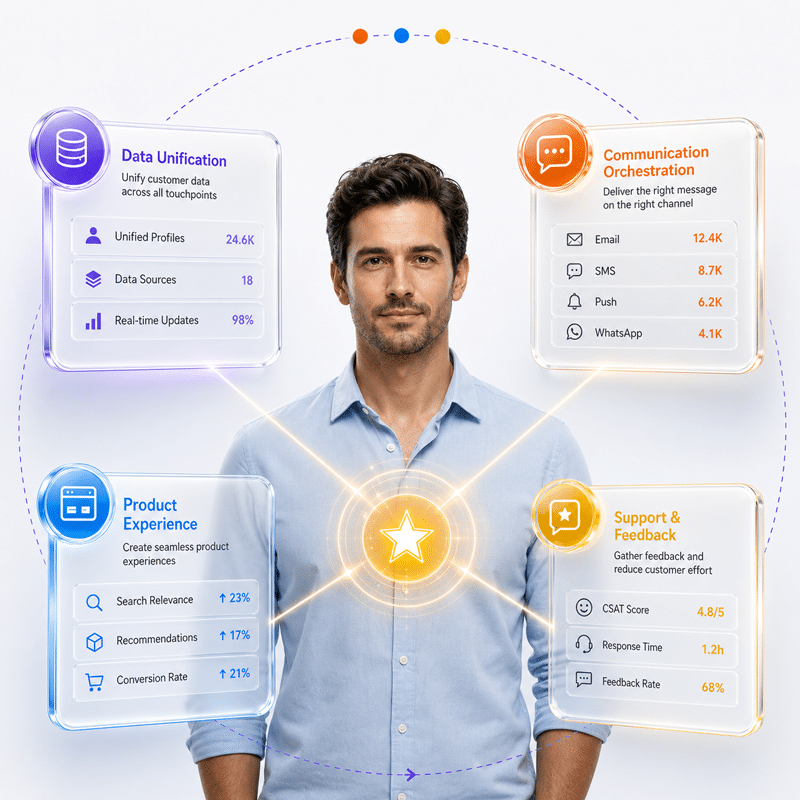
Customer Satisfaction as a System Outcome
Most organizations try to improve customer satisfaction by optimizing individual touchpoints such as support response time, campaign performance, or product usability. While these improvements matter, they rarely create consistent results on their own. In practice, customer satisfaction is shaped by how well different parts of the organization work together. Customers do not experience departments. They experience journeys and when those journeys feel fragmented, even strong individual interactions fail to create overall satisfaction. According to customer satisfaction statistics, a CSAT score above 75 out of 100 is considered good. We will mention the definition and metrics of customer satisfaction in the following paragraphs.
What Is Customer Satisfaction?
Customer satisfaction refers to how well a company meets or exceeds customer expectations across its products, services, and interactions. Although it is often measured through metrics such as CSAT or NPS, these scores represent outcomes rather than the underlying drivers. In reality, satisfaction is cumulative. It develops through repeated interactions, which means that inconsistency over time tends to have a stronger negative impact than a single poor experience. This is one reason why organizations with strong individual teams can still struggle with overall satisfaction levels.
Why Customer Satisfaction Often Stagnates
Many companies invest in improving customer experience, yet see limited progress in satisfaction metrics. This is usually not due to lack of effort, but due to structural limitations. In most cases, teams operate with different tools, datasets, and priorities. Marketing may optimize engagement, product teams focus on usability, and support teams resolve issues. However, these efforts are rarely synchronized in a way that creates a continuous experience. As a result, customers are often required to repeat information, encounter inconsistent messaging, or experience delays between interactions. These friction points accumulate over time, even if each individual interaction is acceptable on its own.
How to Increase Customer Satisfaction Across the Customer Lifecycle
Improving customer satisfaction requires aligning communication, timing, and experience with customer expectations at each stage of the journey. This alignment is rarely achieved through isolated actions, and more often depends on how data and processes are connected.
Improving First Interactions and Onboarding
Initial interactions set the tone for the entire relationship. If onboarding is unclear or requires unnecessary effort, customers begin with uncertainty, which can influence later perceptions even if the product performs well.
In practice, effective onboarding reduces cognitive load. Instead of overwhelming users with features, it guides them through the next logical step based on their context. This is particularly important in digital products where early disengagement is difficult to recover from.
Using Data to Deliver Relevant Communication
Customers are exposed to a high volume of communication across channels, which makes relevance more important than frequency. Generic messaging often leads to disengagement, even when the intention is to increase visibility.
When communication is based on actual behavior, such as browsing patterns, past interactions, or lifecycle stage, it becomes more aligned with customer expectations. However, achieving this level of relevance requires access to unified data, which is often a constraint in fragmented systems.
Maintaining Consistency Across Channels
Customers rarely interact with a brand through a single channel. They move between web, mobile, email, and support environments, expecting continuity in each transition.
Consistency does not mean repeating the same message. It means preserving context. If a customer explores a product on a website, that context should inform subsequent communication. Without this continuity, interactions feel disconnected, even if each one is well executed.
Reducing Friction and Customer Effort
Speed is often highlighted as a driver of satisfaction, but effort plays an equally important role. Customers tend to value experiences that require less repetition, fewer steps, and clearer outcomes.
Reducing friction may involve simplifying processes, anticipating needs, or providing information before it is requested. These improvements are not always visible as features, but they significantly influence how customers perceive the overall experience.
Acting on Customer Feedback in a Structured Way
Collecting feedback is relatively easy, but acting on it consistently is more complex. Feedback often exists in multiple formats, surveys, support interactions, and behavioral signals, which makes it difficult to interpret without a structured approach.
Organizations that improve satisfaction over time tend to treat feedback as an input into decision-making rather than as a reporting metric. This requires connecting qualitative insights with operational changes, which is not always straightforward.
How Customer Satisfaction Is Measured
Customer satisfaction is typically measured through a combination of metrics, each capturing a different aspect of the experience. CSAT focuses on specific interactions and provides immediate feedback. NPS reflects overall loyalty and willingness to recommend. Customer Effort Score measures how easy it is for customers to complete a task. While each metric is useful, none provides a complete picture on its own. In practice, combining these metrics with behavioral data often leads to more accurate insights.
The Role of Data and Systems in Customer Satisfaction
As customer journeys become more complex, maintaining consistency manually becomes increasingly difficult. This is where data and engagement systems begin to play a central role. When customer data is unified, organizations can better understand context, coordinate communication, and respond more effectively to behavior. Without this foundation, even well-designed strategies tend to break during execution. Platforms like PersonaClick support this process by connecting customer data, segmentation, and cross-channel activation. This allows teams to operate with a shared understanding of the customer, although achieving full alignment still depends on how teams adopt and use these systems.
The Operational Reality
Improving customer satisfaction across an organization is rarely a linear process. Technical limitations, legacy systems, and team structures often slow down progress. As a result, most organizations improve incrementally rather than through large transformations. They begin with specific use cases, align processes gradually, and expand capabilities over time. This approach may seem slower, but it tends to be more sustainable in complex environments.
