


Can AI Replace or Amplify Marketing Automation? Understanding the Real Relationship
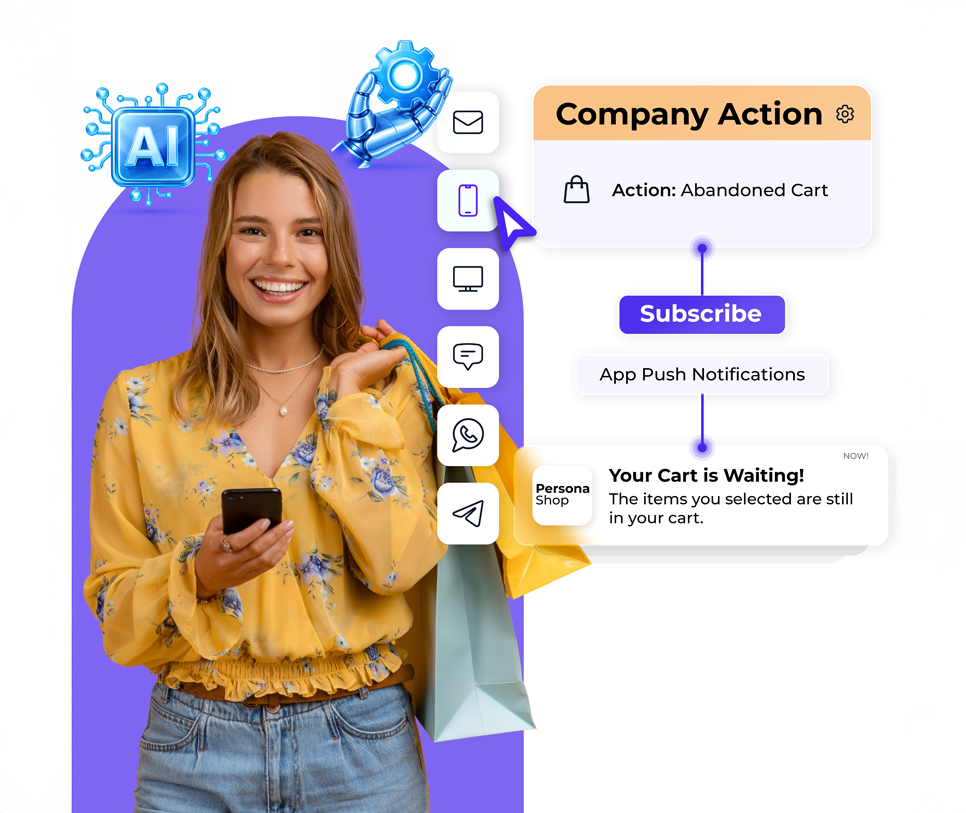
Using AI tools in marketing becomes more widespread day by day. According to statistics, more than 40% of marketing professionals automate repetitive marketing tasks by using AI. Moreover, the rapid rise of artificial intelligence has sparked an important question in modern marketing teams: Can AI replace marketing automation, or does it exist to make it stronger? As AI tools become more capable, some organizations fear automation will become obsolete, while others expect AI to solve every marketing challenge overnight. Indeed, the reality is far more nuanced.In modern practice, AI augments automation by providing behavior-based insights that evolve in real time, while automation delivers consistency and operational execution based on those insights. AI does not replace marketing automation. Instead, it amplifies it. Marketing automation provides structure, consistency, and execution. AI adds intelligence, adaptability, and predictive power. When combined correctly, they form one of the most powerful growth engines available to modern organizations.
Marketing Automation as the Foundation of Scalable Marketing Operations
Marketing automation exists to remove manual effort from repetitive tasks. It ensures that emails, SMS messages, push notifications, and transactional communications are triggered automatically based on customer behavior. Without marketing automation, teams rely on schedules, spreadsheets, and manual decisions that cannot keep pace with real customer journeys.
At its core, marketing automation is about reliability. It guarantees that every customer receives the right communication at the right stage; onboarding emails, cart reminders, post-purchase follow-ups, re-engagement flows; without constant human intervention. This consistency is what allows brands to scale communication across thousands or millions of customers without losing control.
However, traditional marketing automation operates on predefined rules. It follows instructions perfectly, but it does not learn on its own. This is where AI enters the picture.
Why Marketing Automation Alone Has Natural Limitations
Rule-based marketing automation is powerful, but it has boundaries. Teams must decide which segments exist, which triggers matter, and which journeys should run. These decisions are often based on historical assumptions rather than evolving customer behavior.
As customer journeys become more complex, static rules struggle to keep up. Customers do not always follow linear paths. This non-linear behavior becomes especially pronounced in multi-channel journeys where browsing patterns, purchase intent, and engagement signals shift dynamically and unpredictably. That is to say; they browse, hesitate, return, change intent, compare prices, and switch devices. Marketing automation can execute flows flawlessly, but it needs better inputs to stay relevant over time.
This is not a failure of marketing automation, but it simply highlights why intelligence is required to guide it.
How AI Amplifies Marketing Automation Instead of Replacing It
AI does not eliminate the need for marketing automation; it strengthens it by making automation smarter. While marketing automation focuses on when and how to communicate, AI helps determine who, why, and what works best.
AI enhances marketing automation by analyzing massive volumes of behavioral data and identifying patterns humans would miss. It can detect early churn signals, predict purchase intent, estimate price sensitivity, and uncover hidden relationships between customer actions. These insights then feed directly into automated journeys.
In this model, marketing automation becomes the execution engine, and AI becomes the decision-support layer. One without the other is incomplete.
Marketing Automation and AI in Segmentation and Targeting
Segmentation is one of the most critical areas where AI elevates marketing automation. Traditional segmentation relies on static rules: demographics, last purchase date, or basic behavior thresholds. AI-driven segmentation continuously evolves.
AI identifies micro-segments based on real-time behavior, not predefined categories. These AI-driven segments often reveal intent clusters that traditional rule sets miss, enabling marketers to anticipate needs before they surface explicitly. Therefore, AI recognizes which customers are likely to convert, which are drifting away, and which respond best to certain channels or offers. Marketing automation then activates these insights automatically, delivering the right message without manual reconfiguration.
Instead of marketers constantly redefining segments, AI keeps segmentation fresh; and marketing automation ensures those segments are always acted upon.
Marketing Automation Enhanced by AI Across Channels
Email marketing, SMS, push notifications, and onsite experiences all benefit when AI and marketing automation work together. AI can recommend optimal send times, message frequency, and content variations based on individual behavior. Marketing automation ensures these decisions are executed consistently and instantly. Independent research on personalization and engagement shows that personalized experiences consistently drive stronger customer engagement and loyalty compared with static approaches
For example, AI may determine that a specific customer responds better to push notifications than email, or that they convert more frequently in the evening. Marketing automation applies this insight automatically, adjusting the journey without human intervention.
The result is communication that feels intentional rather than repetitive, timely rather than intrusive.
Why AI Cannot Replace Marketing Automation
Despite its capabilities, AI cannot replace marketing automation because AI does not execute on its own. AI does not send emails, trigger SMS messages, manage compliance rules, or orchestrate cross-channel journeys. These operational responsibilities belong to marketing automation.
Without automation, AI insights remain theoretical. Without AI, automation remains static. Their value emerges only when they operate together as a system. Organizations that attempt to “skip” marketing automation in favor of AI quickly discover that intelligence without execution creates bottlenecks, not efficiency.
In practice, the balance between AI insights and automation execution determines whether an engagement system stays relevant at scale or becomes brittle under complex customer patterns.
Marketing Automation with AI at PersonaClick
PersonaClick combines marketing automation with AI-driven intelligence inside a unified customer engagement platform. Behavioral data flows into a single customer profile, where AI analyzes patterns, predicts intent, and supports smarter segmentation. Marketing automation then activates these insights across email marketing, SMS, push notifications, onsite marketing, and product recommendations. This integration allows brands to move beyond rule-heavy workflows and toward adaptive journeys that respond to real customer behavior. Teams no longer need to constantly adjust rules: the system learns, and marketing automation delivers. PersonaClick ensures that automation remains compliant, scalable, and consistent, while AI continuously improves relevance and performance behind the scenes.
The End Result: Smarter Marketing Automation, Not Replacement
The future of marketing is not AI or marketing automation. It is AI with marketing automation. Together, they create systems that listen, learn, and act at a speed and scale no human team can match.
Marketing automation provides stability and execution. AI provides intelligence and evolution. When combined thoughtfully, they transform marketing from reactive workflows into adaptive customer experiences that drive measurable growth.
Ready to see how AI can amplify your marketing automation without adding complexity?
Book a Demo and discover how PersonaClick brings intelligence and automation together in one powerful platform.
