

Why Marketing Automation Matters: From Manual Chaos to Intelligent Customer Experience
For many companies, daily marketing work still relies on a maze of manual tasks: exporting lists, uploading spreadsheets, sending bulk SMS messages by hand, copying last week’s email, or re-creating flows inside different tools. It feels busy, but not productive. In recent years, teams across industries realized something clear: manual work doesn’t scale. Customers move faster than teams can keep up, and with every manual task, the risk of mistakes grows.
This is where marketing automation transforms the entire operational reality of a business. Instead of reacting to customer behavior with delays and repetitive tasks, marketing automation allows brands to communicate in real time, with accuracy, consistency, and personalization that manual processes can never deliver. That is why the marketing automation industry is growing. According to a report by HubSpot, 77% of marketing professionals use marketing automation software to generate content.
1. Why Manual Marketing Work Fails in Modern Digital Journeys
Marketing teams today manage multiple channels, which includes email, SMS, push notifications, on-site banners, and more. When each of these channels requires manual setup, the workload becomes overwhelming. Manually creating an SMS for every abandoned cart, manually sending an email to every new customer, or manually preparing a push notification for each wishlist update is not only exhausting, but also ineffective.
Manual workflows also create lag. By the time a team schedules an email manually, the customer may have already completed their purchase elsewhere. By the time a reminder SMS is sent, the customer’s intent has cooled. Manual work simply cannot match the pace of real customer behavior. Hence, brands need communication that responds instantly, which no human team can sustain at scale.
2. The Risks of Manual Spreadsheet Lists, Manual Bulk SMS Sending & Compliance Mistakes
Many businesses still rely on spreadsheet files to store phone numbers, email lists, or segmentation tables. But a spreadsheet is a temporary storage tool that invites risk.
When teams upload spreadsheet lists into bulk SMS platforms manually, errors happen easily: wrong numbers, outdated data, duplicated contacts, or even customers who previously opted out. For regions like Turkey using İYS, or Europe under GDPR, this isn’t just inconvenient; it’s a legal liability. Unfortunately, manual sending makes it easy to overlook consent rules, ignore updated preferences, or send promotional SMS messages to customers who should only receive transactional ones. Even a single mistake can create fines, customer complaints, or reputational damage.
Marketing automation prevents these errors by syncing consent statuses, suppressing invalid contacts, removing duplicates, and ensuring that every message follows regional compliance guidelines. Automated systems protect the brand, which spreadsheet never will.
3. How Marketing Automation Saves Time and Strengthens Customer Experience
Modern marketing isn’t about sending more messages; it’s about sending the right message at the right moment. Marketing automation makes this possible across email, SMS, push notifications, and transactional communications.
Email automation ensures customers receive personalized onboarding, post-purchase follow-ups, and relevant product suggestions without manual scheduling. SMS automation triggers messages tied to real behavior — cart abandonment, price drops, restocks, loyalty rewards — delivering value instantly. Push notifications reconnect customers who visited but did not return, nudging them gently with content based on their browsing history. Even transactional messages, such as order confirmations or delivery updates, become richer and more informative through dynamic content, improving both trust and clarity.
Instead of a marketer deciding “when to send,” the customer’s behavior becomes the trigger. This shift not only saves hours of manual work each week but also creates a consistent, seamless customer experience.
4. How Marketing Automation Becomes Powerful Through Segmentation
Marketing automation alone is not enough; it becomes exponentially more effective when paired with smart segmentation. Segmentation helps determine who receives what, when, and why.
Customers who browse frequently but don’t purchase require different communication than those who buy often but suddenly go silent. Price-sensitive customers respond better to promotions and price-drop alerts. VIP customers appreciate early access and exclusive benefits. New customers need guidance; returning customers need relevance.
When segmentation feeds marketing automation, every journey becomes tailored. No duplicate messages, no irrelevant offers, no wasted communication. Instead, the customer experience reflects each individual’s patterns, preferences, and needs, which is exactly what drives higher conversions and long-term loyalty.
5. How PersonaClick Elevates Marketing Automation With Unified Data
Marketing automation brings all these elements together by unifying customer data, segmentation, and real-time behavior into one platform. Instead of separate tools for emails, SMS, push notifications, and scattered onsite marketing efforts, PersonaClick centralizes everything in a single ecosystem.
This matters because automation must be fueled by accurate and unified data. If email behavior lives in one system, SMS behavior in another, and push actions in a third, automation becomes inconsistent. PersonaClick solves this by merging browsing data, cart activity, wishlist updates, search patterns, and purchase history into a single profile.
This unified structure allows marketing automation to act instantly and intelligently:
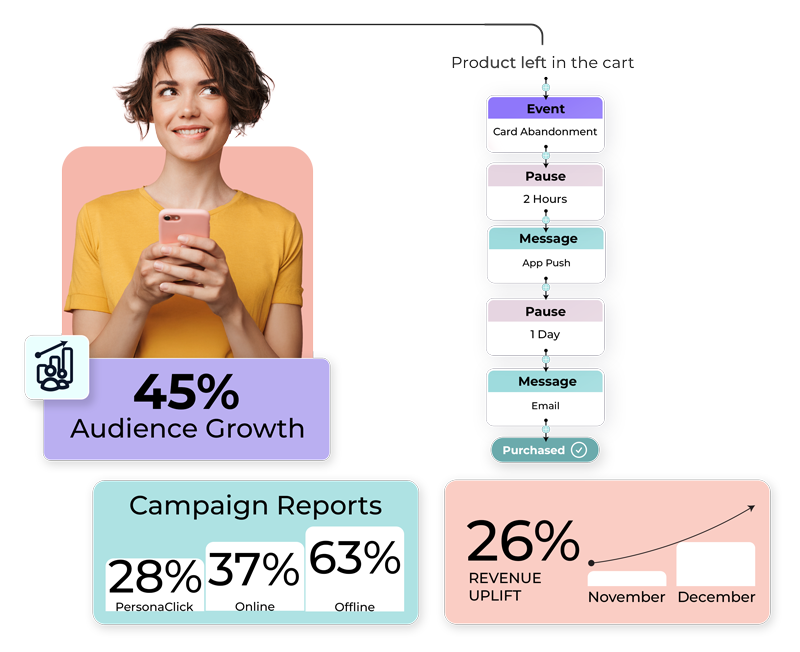
- A customer who abandons a cart receives the right message at the right channel.
- A shopper who repeatedly checks a product gets personalized recommendations.
- A VIP customer receives higher-value offers automatically.
- A dormant customer re-enters automated reactivation flows at the moment inactivity begins.
The system adapts in real time, ensuring that automation never feels robotic, only relevant.
6. End Notes: From Manual Labor to Automated, Customer-First Marketing
Marketing automation isn’t about replacing marketers. Instead, it is about empowering them. Instead of spending hours scheduling campaigns or maintaining outdated lists, teams can focus on creative work, strategy, content, and experimentation. Automation handles the repetitive tasks; humans handle the quality.
When marketing automation is paired with unified customer data and intelligent segmentation, it becomes one of the most powerful engines of business growth. Customers receive communication that feels timely and personal. Brands operate with more efficiency, fewer mistakes, and greater consistency. And revenue rises because the customer journey becomes smoother from start to finish.
✨ Ready to automate your marketing with intelligence, relevance, and real-time insight?
Book a Demo and discover how PersonaClick transforms data into effortless, scalable marketing automation.
