


Customer Lifecycle Marketing: Stages, Use Cases, and How to Implement It
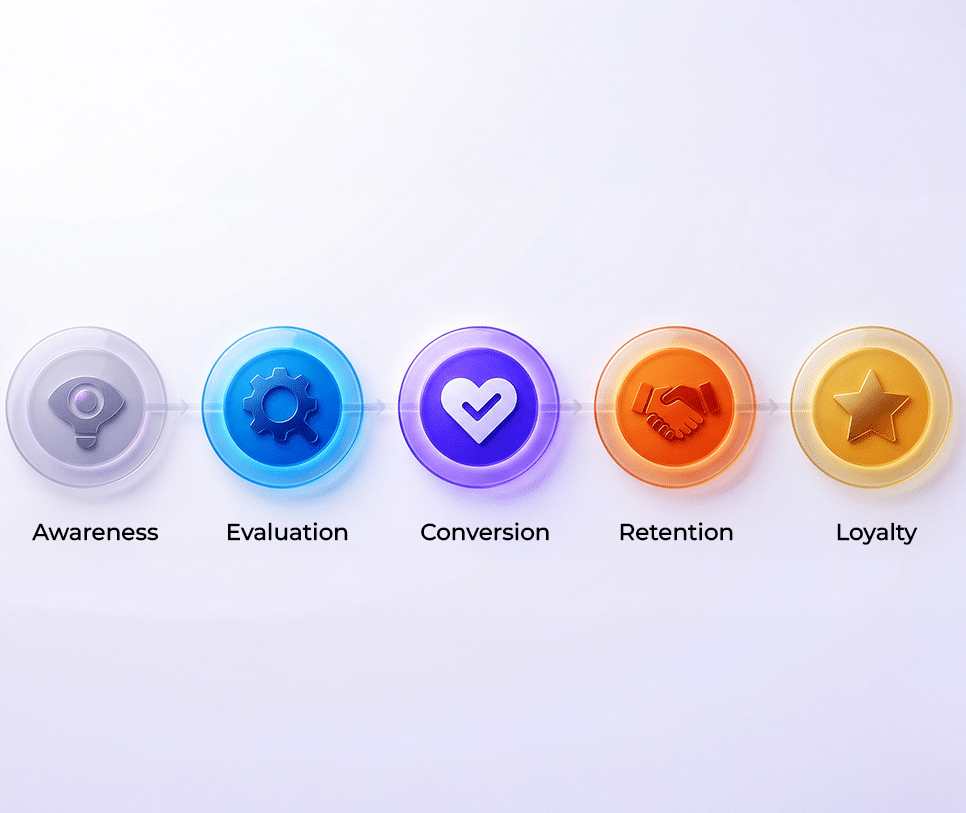
Most companies still approach marketing as a series of disconnected activities, acquisition campaigns, retention emails, and occasional promotions. In practice, this creates fragmented customer experiences and inconsistent performance. Customer lifecycle marketing shifts this perspective by structuring the entire customer journey into connected stages. Instead of asking “what campaign should we run?”, teams begin to ask “where is the customer in their lifecycle, and what should happen next?” This shift becomes particularly important as customer data increases and channels multiply. Without a lifecycle framework, even well-executed campaigns remain isolated. According to, customer lifecycle marketing statistics, only less than 10% of customers define themselves as loyalists, which further proves the importance of the area in contemporary marketing activities.
What is Customer Lifecycle Marketing?
Customer lifecycle marketing is a strategy that organizes customer interactions across defined stages, from initial awareness to long-term retention and advocacy. Each stage requires different messaging, timing, and channel selection. Unlike traditional campaign-based marketing, lifecycle marketing depends on unified customer data, behavioral signals, and automated decision-making When these elements are combined, brands can move from reactive communication to structured, continuous engagement. In practice, lifecycle marketing is rarely implemented fully without a platform that connects data, channels, and automation into a single system.
Customer Lifecycle Marketing Stages and Their Strategic Role
Understanding lifecycle stages is not about labeling users. It is about aligning communication with intent.
Awareness Stage
At the awareness stage, customers encounter the brand for the first time. The objective is not conversion, but relevance. Messaging should introduce value clearly while minimizing friction. In many organizations, this stage is still managed through broad targeting. However, data-driven teams increasingly personalize even the first interaction based on channel, source, or behavioral signals.
Consideration Stage
During consideration, customers actively evaluate alternatives. This is where most drop-offs occur, not because of lack of interest, but because of lack of clarity. Effective lifecycle marketing at this stage requires contextual product communication, use-case-driven messaging, and continuity across channels. If a customer explores a product on mobile and later receives an email, the narrative should remain consistent. This continuity is often where traditional marketing setups break.
Conversion Stage
Conversion is often treated as a single event, but in practice it is a sequence of micro-decisions. At this stage, timing becomes critical. Behavioral triggers such as cart abandonment, product views, or session activity provide strong signals for intervention. Companies that implement lifecycle marketing properly rarely rely on generic campaigns here. Instead, they use automated flows that adapt based on user behavior.
Retention Stage
Retention is where lifecycle marketing begins to compound value. After the first conversion, the focus shifts to maintaining relevance. Customers expect continuity, not repetition. Sending the same message to every user at this stage is one of the most common failure points. Retention strategies typically involve personalized recommendations, channel orchestration (email, SMS, push), and timing optimization. When supported by segmentation and automation, retention becomes predictable rather than reactive. This is also where lifecycle marketing directly overlaps with customer retention software and engagement platforms.
Loyalty and Advocacy from Customer Lifecycle Marketing Perspective
At the final stage, customers are no longer just buyers. They become repeat users and, in some cases, advocates. However, loyalty is rarely built through rewards alone. It emerges from consistent experiences across the entire lifecycle. Brands that succeed here usually have one common trait: they maintain a unified view of the customer across all interactions.
Customer Lifecycle Marketing Use Cases Across Industries
Customer lifecycle marketing is not limited to one sector. Its application varies depending on how customer journeys are structured.
- In e-commerce, customer lifecycle marketing often revolves around product discovery, cart behavior, and repeat purchases. A user who browses products, abandons a cart, and later receives a personalized recommendation represents a typical lifecycle flow.
- In travel, timing and context are more critical. Booking confirmations, reminders, and real-time updates form a connected experience that extends beyond a single transaction.
- In financial services, lifecycle marketing focuses on trust and consistency. Notifications, alerts, and personalized communication play a larger role than promotional messaging.
How to Implement Customer Lifecycle Marketing
Implementing lifecycle marketing requires more than defining stages. It requires operational alignment. At a minimum, three components must work together:
Unified Customer Data
Without a centralized data structure, lifecycle stages cannot be identified accurately. Data from web, mobile, CRM, and messaging channels must be connected.
Channel Coordination
Customers do not think in channels. They move between them. Lifecycle marketing requires communication to follow that movement without losing context.
Automation and Orchestration
Manual campaign management cannot scale lifecycle marketing. Automated workflows, triggered by behavior and data, are necessary to maintain continuity.
Platforms like PersonaClick are designed to support customer lifecycle marketing by combining customer data, automation, and omnichannel marketing into a single system. In practice, this reduces fragmentation and enables marketing teams to operate with a lifecycle perspective rather than a campaign mindset.
Why Customer Lifecycle Marketing Matters for Long-Term Growth
Lifecycle marketing does not produce immediate results in the same way as acquisition campaigns. Its impact emerges over time through improved retention, higher engagement, and more efficient communication. Companies that invest in lifecycle marketing often notice a shift in how performance is measured. Instead of focusing only on short-term conversions, they begin to track customer lifetime value, retention rates, and engagement depth. This shift is not always easy to implement, especially in organizations where teams are structured around channels rather than customer journeys.
Final Thoughts about Customer Lifecycle Marketing
Customer lifecycle marketing is not a feature or a tool. It is a way of structuring how marketing operates. As customer expectations continue to evolve, disconnected campaigns become less effective. What replaces them is not necessarily more content or more channels, but better coordination. And that coordination depends on how well data, automation, and communication are brought together.
