


How a CDP Empowers a Marketing Ecosystem: A General Exploration
Modern marketing teams already collect vast amounts of customer data. Website interactions, mobile activity, email engagement, purchase history, and support interactions all generate signals. Yet in many organizations, these signals remain disconnected. The result is not a lack of data, but a lack of continuity. Campaigns operate in isolation, customer experiences feel fragmented, and teams rely on assumptions instead of real-time behavior.
A Customer Data Platform (CDP) addresses this gap by transforming scattered data into a unified system. When implemented effectively, it does not simply store data, it enables coordination across segmentation, automation, and communication. This is what turns data into a functioning marketing ecosystem.
What Is a Customer Data Platform (CDP)?
A Customer Data Platform is a system that collects, unifies, and activates customer data from multiple sources into a single, continuously updated profile. However, the role of a CDP extends beyond data management. Within a marketing ecosystem, it acts as the central layer that connects:
- data collection
- audience segmentation
- campaign automation
- cross-channel communication
Without this central layer, each function operates independently. With it, marketing becomes a coordinated system where every action is informed by real-time customer behavior.
Why Most Marketing Ecosystems Remain Fragmented
Many organizations attempt to build connected customer experiences while relying on disconnected tools. Email platforms, analytics tools, CRM systems, and advertising platforms often operate with separate datasets. This fragmentation creates several challenges. Customer profiles become inconsistent, campaigns lose context, and communication across channels feels repetitive rather than continuous.
In practice, the issue is rarely strategic. Most teams understand the importance of personalization and cross-channel consistency. The constraint is operational. Systems are not designed to share data in real time, and teams are structured around channels rather than customer journeys. As a result, what appears to be an omnichannel or data-driven strategy often functions as a collection of loosely connected campaigns.
How a Customer Data Platform (CDP) Enables a Connected Marketing Ecosystem
A CDP does not replace marketing tools. It connects them.
Unified Customer Data as the Foundation
The first step is consolidating customer data from all available sources. Website activity, mobile interactions, CRM records, transaction history, and third-party data are merged into a single profile. This unified view allows teams to move beyond channel-specific insights and understand the customer as a whole. Without this foundation, any attempt at personalization remains limited.
Behavioral Segmentation and Audience Intelligence
Once data is unified, segmentation becomes dynamic rather than static. Instead of relying on predefined lists, audiences are continuously updated based on behavior. Customers can be grouped by:
- engagement patterns
- purchase frequency
- lifecycle stage
- intent signals
This allows marketing teams to respond to what customers are doing, not just who they are.
Marketing Automation Driven by Real-Time Signals
Automation becomes significantly more effective when it is connected to real-time data. Instead of scheduling campaigns manually, workflows are triggered by customer behavior. A user who abandons a booking flow, revisits a product category, or becomes inactive can be engaged automatically with relevant messaging. The key shift here is timing. Communication is no longer based on fixed schedules, but on customer actions.
Cross-Channel Personalization and Activation
A connected ecosystem ensures that communication remains consistent across channels. Email, SMS, push notifications, onsite messaging, and mobile apps operate from the same data source. When a customer interacts with one channel, that context carries into the next. This reduces repetition and creates a more coherent experience. Personalization in this context is not limited to content. It includes timing, channel selection, and message sequencing.
The Operational Reality of Customer Data Platform (CDP) Implementation
While the concept of a connected ecosystem is straightforward, implementation is rarely immediate. Many organizations operate with legacy infrastructure that was not designed for real-time data sharing. Customer data may exist in multiple systems, each with different formats and update cycles. Aligning these systems requires both technical integration and organizational coordination.
In practice, CDP adoption often begins with specific use cases rather than a full transformation. Teams may start with a limited set of data sources or a single channel before expanding the system over time. The challenge is not only building the infrastructure, but also adapting workflows, responsibilities, and decision-making processes to operate within a unified system.
Why a Customer Data Platform (CDP) Changes How Marketing Teams Operate
The impact of a CDP is not limited to campaign performance. It changes how marketing teams work.
When data, segmentation, and activation are connected, teams shift from managing campaigns to managing systems. Decisions are based on behavior rather than assumptions, and communication becomes continuous rather than episodic.
One of the most practical outcomes is reduced delay between customer action and business response. Instead of reacting after a campaign ends, teams can respond as behavior unfolds.
Over time, this reduces inefficiencies, improves coordination across teams, and creates a more consistent customer experience.
The Role of PersonaClick in a Connected Marketing Ecosystem
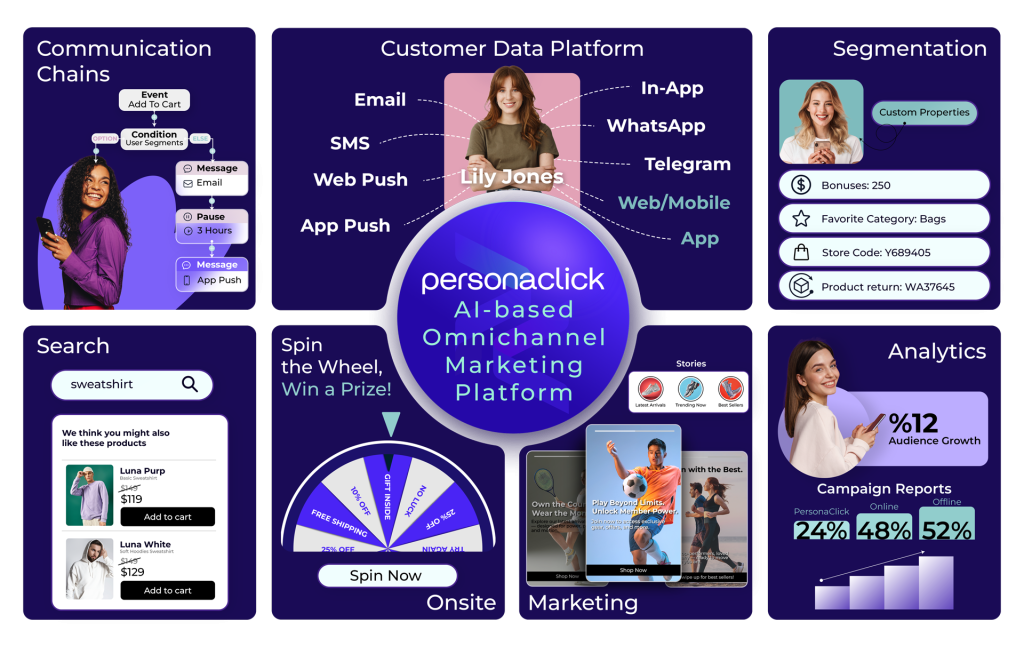
PersonaClick is designed to reduce the gap between customer data and activation by combining CDP capabilities with segmentation, automation, and cross-channel communication. Customer data from web, mobile, CRM, and engagement channels is unified into a single profile. This allows marketing teams to build dynamic segments, automate journeys, and deliver consistent messaging across channels such as email, SMS, push notifications, and onsite experiences. Rather than managing separate tools, teams operate within a connected environment where data, decisions, and communication are aligned. This reduces fragmentation and enables marketing to function as a coordinated system.
Customer Data Platform is a Value Channel
A CDP does not create value simply by centralizing data. Its impact comes from enabling coordination. As customer journeys become more complex and multi-channel, disconnected tools and isolated campaigns become less effective. What replaces them is not necessarily more technology, but better integration between data, teams, and communication. The question is no longer whether organizations have enough data. It is whether they can act on it in a way that feels continuous to the customer.
