

How to Choose the Right Email Marketing Software for Modern Customer Engagement
Choosing an email marketing software is no longer a simple tool comparison. Email is now a core driver of customer experience, which includes shaping onboarding, retargeting, loyalty, post-purchase communication, and long-term engagement. According to Statista, the number of global email users reached 4.37 billion in 2023 and is expected to grow up to 4.89 billion by 2027. That is why email marketing is an inexpensive yet very important channel for marketers to engage with their customers. Moreover, in recent years, expectations have grown dramatically: customers want relevant messages, brands want automation instead of manual work, and regulations require strict compliance.
That means selecting an email marketing software is a strategic decision, not a technical one. The right platform must unify data, personalize journeys, respect consent laws, and scale with your business. The wrong one creates friction, manual labor, data inconsistencies, and lost revenue.
Here’s how to make the right choice.
1. Data Quality & Real-Time Customer Understanding of the Email Marketing Software
The strongest email strategy begins long before hitting “send.” Your email marketing software must understand your customers, which includes important customer touchpoints such as what they browse, what they purchase, what they ignore, what they return to, and how they behave across channels.
This means the software should not rely solely on uploaded lists. It should connect to your website, CRM, mobile app, SMS marketing software, and customer engagement platforms. If the software can’t unify behavioral data, it cannot personalize effectively.
Brands should ask:
- Does the email marketing software update customer profiles in real time?
- Does it reflect browsing history and purchase behavior?
- Can it combine online and offline activity?
- Does it merge identities across devices?
Customer understanding is the foundation. Without it, even beautifully designed emails miss the mark.
2. Automation Capabilities That Replace Manual Work of the Email Marketing Software
Email marketing teams today cannot afford manually sending bulk campaigns, rewriting onboarding emails monthly, or rebuilding abandoned cart flows from scratch. The right email marketing software must automate these journeys intelligently.
Look for:
- Triggered emails based on customer behavior
- Automated onboarding sequences
- Post-purchase follow-ups that change with order status
- Back-in-stock or price-drop alerts
- Abandoned cart and abandoned browse flows
- Loyalty and win-back sequences
- Personalized product recommendations inside automated emails
If the platform still requires manually scheduling every communication, it is not a true email marketing software; it’s a sending tool. Automation should make your communication continuous, adaptive, and effortless.
3. Segmentation Depth & Personalization Power of the Email Marketing Software
Segmentation determines whether your emails feel relevant or generic. Many brands struggle because their segmentation is limited to basic attributes like gender or city. True segmentation must be behavioral and dynamic.
Your email marketing software should support:
- Real-time segment updates
- Behavioral segmentation (browsing, wishlist, cart, purchase patterns)
- Predictive segments (at-risk customers, likely buyers)
- RFM segmentation
- Price sensitivity markers
- Interest-based groups
When segmentation is shallow, personalization becomes impossible. When segmentation is rich, emails feel custom-made; even inside a fully automated system.
4. Compliance, Consent & Legal Reliability of the Email Marketing Software
Compliance is non-negotiable. Whether you operate in regions requiring GDPR, KVKK, or İYS, your email marketing software must respect customer consent and keep your brand safe.
Critical questions to ask:
- Does the platform automatically track and honor opt-outs?
- Does it integrate with centralized consent systems (like İYS)?
- Does it suppress unsubscribed or inactive contacts automatically?
- Does it support transactional vs. promotional message separation?
- Does it maintain clean, validated email lists?
Manual compliance management is a risk no brand should take. Inaccurate consent handling can lead to fines, customer complaints, and long-term trust erosion.
5. Multi-Channel Alignment Capability of the Email Marketing Software
Email cannot operate alone anymore. It must work alongside SMS, push notifications, onsite banners, product recommendations, and web personalization. The ideal email marketing software works as part of a connected ecosystem—not an isolated channel.
It should be able to:
- Share segments with SMS and push channels
- Trigger emails based on push or onsite actions
- Use the same unified customer profile across channels
- Provide cross-channel analytics on customer journeys
- Avoid duplicate messaging by coordinating timing
A disconnected email system leads to fragmented customer experiences. A unified one leads to consistency, clarity, and better conversions.
6. Analytics That Show Real Revenue Impact of Using the Email Marketing Software
Open rates, click-through rates, and delivery metrics are helpful, but they are not enough anymore. Brands need revenue visibility.
A strong email marketing software must reveal:
- How much revenue a campaign generated
- Which segments convert best
- How email interacts with SMS and push
- Customer lifecycle metrics
- Automated journey performance
- RFM improvement over time
Without revenue attribution, email strategy becomes guesswork. Analytics should provide clarity, not vanity.
7. Ease of Use & Team Collaboration Enabled by the Email Marketing Software
Even the most powerful tool becomes worthless if your team can’t use it. Modern email marketing requires fast adaptation, rapid testing, and collaborative workflows.
Evaluate whether the software:
- Has a clean, intuitive interface
- Allows fast email building without coding
- Supports dynamic content blocks
- Makes segmentation effortless
- Reduces dependency on technical teams
- Simplifies day-to-day workflows
Your software should remove friction, not add more.
8. Why PersonaClick Is the Right Email Marketing Software for Customer-Centric Brands
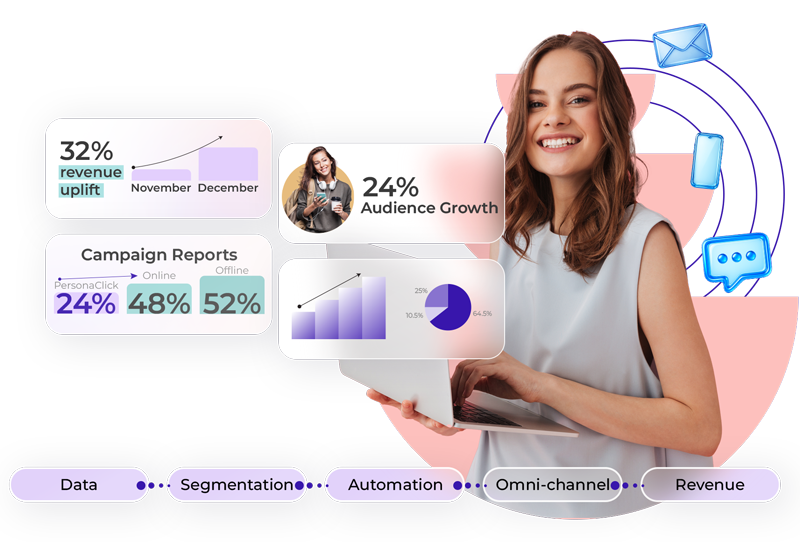
PersonaClick as an email marketing software brings together unified customer data, real-time behavioral tracking, segmentation, email automation, SMS, push notifications, onsite personalization, and analytics inside one platform. Instead of stitching multiple tools together, brands gain a complete, synchronized ecosystem for customer engagement.
With PersonaClick as your email marketing software, you get:
- Real-time data unification across all touchpoints
- Behavior-driven automated journeys
- RFM and predictive segmentation
- GDPR, KVKK, and İYS-safe consent management
- Onsite + email + SMS + push channel orchestration
- Automated cart recovery, wishlist triggers, and personalized recommendations
- A modern, visual interface built for speed and clarity
It is not just a sending tool. It is a brain using data to design intelligent customer journeys that feel personal, helpful, and timely.
Conclusion: Choose an Email Marketing Software That Works With You, Not Against You
Your email marketing software should save time, reduce risk, increase relevance, and unify your customer experience across every channel. It should help you understand your customers, communicate meaningfully, and grow revenue without relying on manual work or fragmented systems.
The right platform makes marketing feel effortless. The wrong one makes it feel endless.
✨ Ready to see how a unified, intelligent email marketing software transforms your business?
Book a Demo and experience how PersonaClick turns customer data into engagement, personalization, and long-term loyalty.
