

Executive Summary
Personalizing Hotel Experiences with Behavioral Segmentation
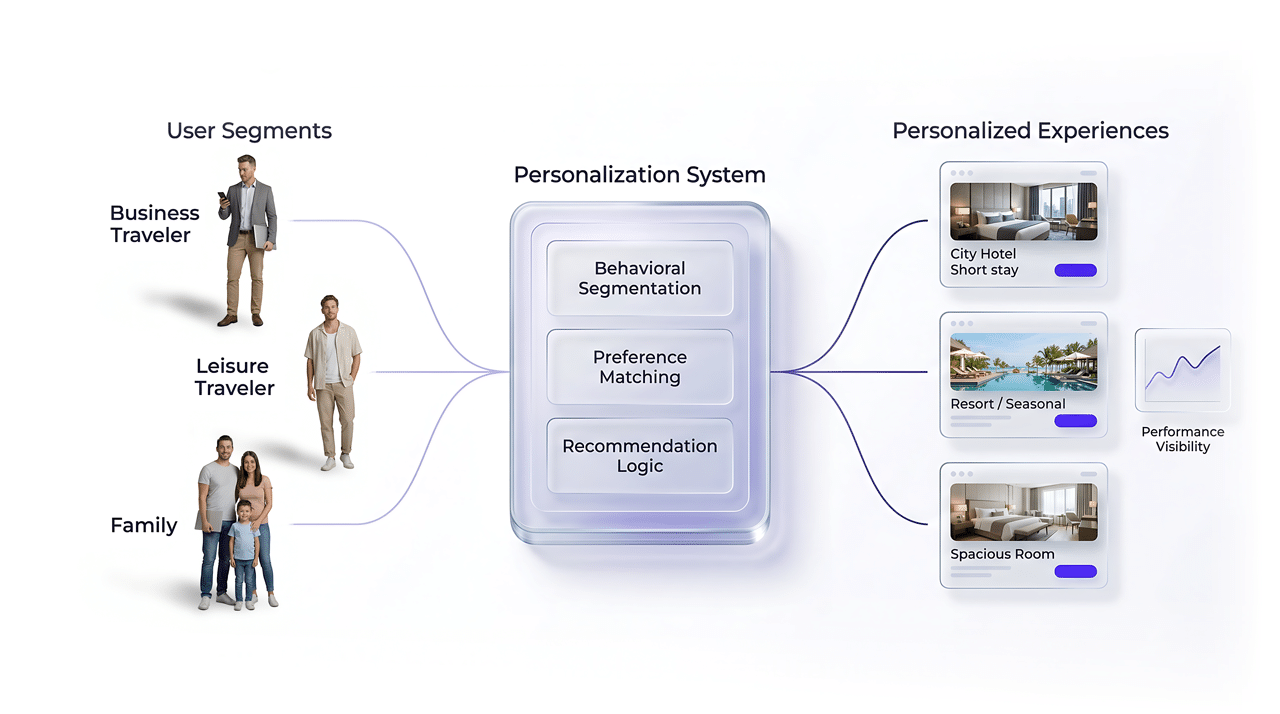
In hospitality, users rarely approach booking with the same expectations. Even when platforms offer similar inventory, decision-making shifts depending on the purpose of travel. A business traveler prioritizes speed and location, while a family focuses on comfort and space. When communication treats these different contexts the same, relevance gradually declines. Although each booking may seem independent, travel behavior tends to follow repeatable patterns shaped by timing, location, and preferences. Without structuring these patterns, marketing efforts rely on fragmented signals and miss the opportunity to align with real user intent. This playbook explores how leveraging behavioral segmentation transforms raw travel data into structured audience groups, enabling personalized hotel experiences that reflect how users actually travel. By combining stay data, booking patterns, and contextual signals, brands can move from generic messaging to behavior-driven engagement. Over time, personalization becomes more consistent, and communication aligns naturally with user expectations across different travel moments.
Segmentation-Focused Playbook
Turn travel behavior into personalized booking experiences
This playbook explores how behavioral segmentation transforms fragmented stay data into structured audience groups, enabling more relevant and consistent hotel recommendations.
Generic Messaging Problem
Why uniform communication reduces relevance
Users approach travel with different intentions, yet communication often treats them as a single segment.
-
Business, leisure, and family travelers have distinct expectations that generic messaging fails to address.
-
Static segmentation cannot adapt to changing travel contexts and behaviors.
-
Over time, irrelevant recommendations reduce engagement and booking intent.

Behavioral Segmentation Logic
How travel patterns become actionable segments
Behavioral segmentation organizes historical stay data into meaningful, repeatable patterns.
-
Signals such as location, length of stay, booking timing, and hotel category are evaluated together.
-
Booking composition, including group size and family context, adds deeper behavioral insight.
-
Patterns stabilize over time, allowing the system to recognize intent based on behavior rather than isolated data points.

Personalized Experience Impact
What changes when personalization reflects real behavior
When segmentation aligns with how users actually travel, communication becomes more coherent and effective.
-
Users receive hotel recommendations that match their travel purpose and expectations.
-
Engagement improves as interactions feel more relevant across channels.
-
Booking journeys become easier to follow and optimize due to clearer behavioral signals.